+
there is no tooth fairy.
or fix a flat fairy.
or put the dishes away fairy
or wash the dishes fairy
And it's not me.
MOM
+
Thursday, April 14, 2011

Monday, April 4, 2011
into the light
+
"with excuses to Sondheim - we will see 'Into the Woods' next week. Love that show.
Lent 4A, April 4/5, 2011 – “Into the Light” The man born blind – John 9
Ahh, another one of our long, long readings from the Gospel according to John. It’s a wonderful story, full of drama and development. The progress of the man-born-blind is amazing – from beggar to healed man to witness to confessor. At the beginning of the story he exists in darkness – and at the end he stands in the light of Jesus the Christ and worships the one who healed him.
Along the way – eyes are opening and closing among all sorts of people. Jesus refuses to attribute the man’s blindness to sin, probably startling the disciples. Instead he insists that this is a moment for God’s light to shine, to act. The theme of the whole story is how do people react when God’s light shines upon them? Do they, and do we – see? Or do we retreat back into darkness, into comfortable and safe places of rules and limitations? We learn about three ways of responding to the Light of the World.
The Pharisees cannot see this miracle for what it is – the work of God bringing light into the world – the presence of God as the light of the world - in the world. No, their eyes remain closed to the light, bounded by their own interpretation of sin and righteousness, their own fear for their control of religious things. They create their own darkness. All of us, except the greatest saints, I suspect, do this at times – we fear what change might bring – we cling to what has worked for us in the past. Do not condemn those Pharisees too quickly, for there may be a family resemblance.
The most poignant paragraph concerns the parents, I think – what confusion and fear they undergo! Finally, they retreat, for safety, into the dusk – not understanding what is happening to their son. Not understanding what would happen to them if they entered into the light.
Because coming into the light – experiencing the healing – the everyday elements of mud and spit and water changes everything for the man-born-blind. This nameless person – loses his identity, you see, loses his income, loses his parents, loses his place in the community, in the synagogue – but he receives everything – he learns to worship in Spirit and in Truth (from last week). He is set free for freedom’s sake – for the glory of God – and in the part of the story that is never told, he must become a disciple, a follower of Jesus, a student of the Master, a sheep of the flock, inheritor of the Kingdom of God.
Coming into the light may mean loss. Certainly loss of the comfortable rationalizations of sins – Someday I’ll do better, we say. Someday God will come first. Someday I’ll be ready for prayer, for service, for generosity. Someday God will be more important to me. Coming into the light may mean loss. Loss of sin – are we ready for that? Loss of distraction by the things of this world, loss of false directions, of false standards.
Coming into the light – means loss – and gain. That is the hope of this story – we gain so much when walk in the light. When we come to the water – as babies for the first time, or as adults remembering what God did for us (as adults witnessing this child being washed by God love) – we find a hint of what we gain –
Peace, and joy, and purpose.
We gain a chance to correct our mistakes, to step out in hope and faith, opportunities to do good, to serve, to care. We gain conviction that what we can do makes a difference. And finally, we gain hope that this life is not all there is – that we are part of a greater reality – a reality of light in the world, light that began with, yes, mud and spit and water and wine and bread and a cross and love.
+
"with excuses to Sondheim - we will see 'Into the Woods' next week. Love that show.
Lent 4A, April 4/5, 2011 – “Into the Light” The man born blind – John 9
Ahh, another one of our long, long readings from the Gospel according to John. It’s a wonderful story, full of drama and development. The progress of the man-born-blind is amazing – from beggar to healed man to witness to confessor. At the beginning of the story he exists in darkness – and at the end he stands in the light of Jesus the Christ and worships the one who healed him.
Along the way – eyes are opening and closing among all sorts of people. Jesus refuses to attribute the man’s blindness to sin, probably startling the disciples. Instead he insists that this is a moment for God’s light to shine, to act. The theme of the whole story is how do people react when God’s light shines upon them? Do they, and do we – see? Or do we retreat back into darkness, into comfortable and safe places of rules and limitations? We learn about three ways of responding to the Light of the World.
The Pharisees cannot see this miracle for what it is – the work of God bringing light into the world – the presence of God as the light of the world - in the world. No, their eyes remain closed to the light, bounded by their own interpretation of sin and righteousness, their own fear for their control of religious things. They create their own darkness. All of us, except the greatest saints, I suspect, do this at times – we fear what change might bring – we cling to what has worked for us in the past. Do not condemn those Pharisees too quickly, for there may be a family resemblance.
The most poignant paragraph concerns the parents, I think – what confusion and fear they undergo! Finally, they retreat, for safety, into the dusk – not understanding what is happening to their son. Not understanding what would happen to them if they entered into the light.
Because coming into the light – experiencing the healing – the everyday elements of mud and spit and water changes everything for the man-born-blind. This nameless person – loses his identity, you see, loses his income, loses his parents, loses his place in the community, in the synagogue – but he receives everything – he learns to worship in Spirit and in Truth (from last week). He is set free for freedom’s sake – for the glory of God – and in the part of the story that is never told, he must become a disciple, a follower of Jesus, a student of the Master, a sheep of the flock, inheritor of the Kingdom of God.
Coming into the light may mean loss. Certainly loss of the comfortable rationalizations of sins – Someday I’ll do better, we say. Someday God will come first. Someday I’ll be ready for prayer, for service, for generosity. Someday God will be more important to me. Coming into the light may mean loss. Loss of sin – are we ready for that? Loss of distraction by the things of this world, loss of false directions, of false standards.
Coming into the light – means loss – and gain. That is the hope of this story – we gain so much when walk in the light. When we come to the water – as babies for the first time, or as adults remembering what God did for us (as adults witnessing this child being washed by God love) – we find a hint of what we gain –
Peace, and joy, and purpose.
We gain a chance to correct our mistakes, to step out in hope and faith, opportunities to do good, to serve, to care. We gain conviction that what we can do makes a difference. And finally, we gain hope that this life is not all there is – that we are part of a greater reality – a reality of light in the world, light that began with, yes, mud and spit and water and wine and bread and a cross and love.
+
Sunday, February 20, 2011
gleaning on the edge
+
A much, much shorter version of this sermon was preached today after the endowment committee gave away lots of money. It was a nice tie-in to the messy, foolish, openhanded community.
Seventh Sunday of Epiphany, 2011 – Matthew 5:38-48, Lev. 19:1-2, 9-18
“Gleaning on the Edge” –
When we went to Germany, we also wanted to see the part of Poland where my husband’s ancestors came from – what was once Greater Pomerania – now it’s Poland. Driving across north east Germany, we all commented how much it looked like Wisconsin. The fields were reasonably sized, with hedgerows of pine and other trees. There were sections of woods, there were occasional farm buildings. It looked like a hospitable land, homey, a good place to live. That all changed when we crossed the border into Poland. The same topography, the same hills and valleys, the same farmland, had been opened up by the communist agricultural system. The fields were massive, huge, endless. There were no edges with trees, no small woodlots, there were no old farmsteads – all had been taken away. There were no hiding places for deer, for foxes, for wild animals at all. The farmers lived in apartment buildings in tiny villages – cramped together while surrounded by all that vast landscape. All was devoted to production –and all was about production with no waste allowed.
I tell you this story because I was most struck this week not just by Jesus’ strong words about relations with our neighbors and our enemies, but by one little verse in the Old Testament Lesson – which gives us a new way of looking at the words of Moses and Jesus.
In Leviticus - which is a book that I know most of us would rather ignore – God puts forth detailed instructions for his people. God desires his people to be holy, as he is holy. God wants his people to be good, as he is good. Jesus interprets this – be ye perfect, as our heavenly father is perfect. Jesus’ words are based on this Hebrew Bible tradition – the Ten Commandments and the elaboration of them throughout history. Let’s not discard this Law too quickly. It was important to our Savior, it should be important to us, too.
Perfection, Goodness, Holiness. That seems like too much for us, doesn’t it? We want to hear that there are ways out of those kinds of expectations. We are sinners, we know, we are imperfect, we just not capable of that kind of perfection. Many of the commentators and preachers I read and hear try to explain away Jesus’ words, explain away Moses’ words – wave them away so we can go living as we want to. The basic message is – since it’s impossible to be perfect – why even try? Since we’re not born holy – let’s enshrine all our sins, all our weaknesses and say that Moses and Jesus really didn’t understand human existence – that Moses and Jesus are asking too much of us.
Human life is messy. It is. We love imperfectly. We make mistakes. We are greedy. We are selfish. We try to tie everything up into bundles and keep our stuff safe and we become territorial and emotional and we can hurt each other. And all those elements of our being – those are part of the great gap between us and God. So are Moses and Jesus asking too much of us? I think that’s the wrong question to dwell on – let’s look at what is being asked of us.
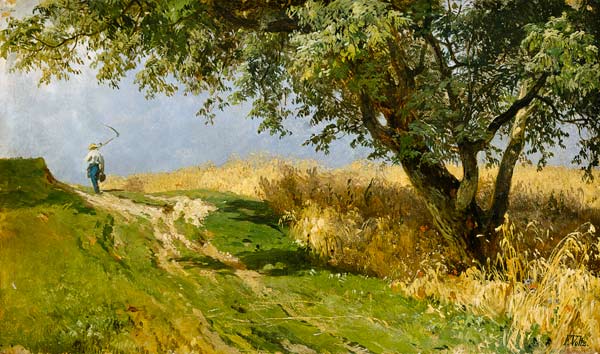
That’s where the image of gleaning comes in. Gleaning is exactly described right there in Leviticus 19:9 – when you reap the harvest of your land, you shall not reap all the way to the edge of your field, or gather the gleanings of your harvest. You shall not strip your vineyard bare, or gather the fallen grapes. You will leave them for the poor and the alien: I am the Lord your God. Gleaning is a harvest practice . . . it means to leave behind wheat in the field, grapes on the vines, olives and apples on the trees.
Don’t be too neat when you garden. Remember the fields of Poland and the fields of Germany? There could be no gleaning from the fields of Poland – they were too aggressively cultivated, too neatly manicured. God wants his people to be messy harvesters. It has something to do with holiness, God says. I am holy – you shall be holy – and people of a holy God do this: they are messy harvesters. They are called to be messy at the harvest for the sake of others – for the poor, for those who are passing through, those who have no one else. They are called to be open-handed to the neighbor. They are called to be foolish – not playing politics and treating the rich any better than the poor.
Does that have to do with us, and that question – Are Moses and Jesus asking too much of us? I think it does. The Old Testament world, and the Old Testament laws, and Jesus’ world and Jesus’ words – love your neighbor, love your enemies, give your coat and your cloak, don’t hit back, give charity freely, lend openly – all that stuff is related to call of God to God’s people – be holy. Be a holy community.
Be a community – that’s the key. Gleaning – the process of sharing the harvest with those in need – is a community thing. God’s command to allow gleaning points all of us to remember that we are not put here just for ourselves. We are not put here to neatly tie up all the ends and be secure by ourselves, in ourselves. People need people – as the song says – and people interact in all sorts of ways – we are messy with each other. And that is part of being a living, holy - messy, open-handed, foolish community.
The call to live together underlies all of Jesus’ Sermon on the Mount. We hear those things that sound so tough – if someone takes from you your coat, give them your cloak also, hit on one cheek, turn the other. And if we are thinking of ourselves as solitary individuals, as only me, then, yes, this doesn’t make sense. But, Jesus isn’t thinking like that, like we are all alone, not at all. If you are forced to give your coat and your cloak away – then your neighbor, your community, will come to your aid. If you are being beaten up, then your community should step in to protect you.
Be a holy community, says God to Moses in the Hebrew Bible. Be a living community, says Jesus to the disciples and to us on the Sermon on the Mount. Go ahead, be messy around the ends. Be generous and kind, give to people who don’t deserve it. Don’t harvest to the edge of the field, but share with your neighbor and those who are in need. Watch out for those who are being battered on one cheek and the other, for those who have lost their coat and cloak, for those whose miles are longer and harder than yours. Be a community that loves the neighbor, that allows itself to be messy and open handed and foolish.
For Jesus himself was messy and open-handed, and foolish – and look what he did for us. Amen.
+

Thursday, January 27, 2011
the deal
+
here's the deal.
Life - is busy.
I've started to classes, both of which start with psycho-. Tells you something, no?
Psychopathology & Psychometrics. Pathology is on Thursday night. Metrics is on Saturday morning.
Psychometrics is the old testing and assessment class. My math and statistics are far, far behind me. This should be good.
And this week I accepted the role of chair of the 150th anniversary at Peace. We have enough money to pay the guest preachers and nothing else right now. I did not know this when I accepted the job. It will be an interesting year.
I'm not preaching as often, and that's okay. Life is busy. Things need to get done. I'm putting on my do-it hat and doing-it. Sometimes that makes me cranky. I will work on taking my time for prayer and mediation and exercise and eating right. Somewhere in there.
Anyone know someone with an Axis I diagnosis who is willing to be my interview subject?
Life goes on in the frozen north. But not as snowy as the north-east at least.
+
here's the deal.
Life - is busy.
I've started to classes, both of which start with psycho-. Tells you something, no?
Psychopathology & Psychometrics. Pathology is on Thursday night. Metrics is on Saturday morning.
Psychometrics is the old testing and assessment class. My math and statistics are far, far behind me. This should be good.
And this week I accepted the role of chair of the 150th anniversary at Peace. We have enough money to pay the guest preachers and nothing else right now. I did not know this when I accepted the job. It will be an interesting year.
I'm not preaching as often, and that's okay. Life is busy. Things need to get done. I'm putting on my do-it hat and doing-it. Sometimes that makes me cranky. I will work on taking my time for prayer and mediation and exercise and eating right. Somewhere in there.
Anyone know someone with an Axis I diagnosis who is willing to be my interview subject?
Life goes on in the frozen north. But not as snowy as the north-east at least.
+
Monday, January 3, 2011
in the world
+
Christmas 2 – Year A – John 1:1-18 –“in the World” – Jan 1
& 2.
He came into the world, and the world came into being through him, and the world knew him not. But to all who received him . . . he gave the power to be children of God.
Happy New Year! I hope you had a good New Year’s Eve – even if you’re the sort that celebrates with New York City at 11 pm, or even New Year’s Eve in Nova Scotia – that’s for those of us who go to bed at 10 pm. It’s interesting how this date has become a cultural phenomenon – it’s all about
retrospectives of films, tv, music, news stories – what was thought to be important – and about looking forward – the bit about resolutions – plans and dreams that are unlikely to be carried out.
And all this for what is an arbitrary date, really. It’s a remnant of the old pagan solstice as much as anything. Why do we bother to make New Year's resolutions in the first place? Why do we feel this need each January 1 to set new goals? We hear things like: It is up to each of us to maximize the potential of every moment. It becomes all up to us to transform ourselves. Most of the New Year’s stuff we are exposed to, is all about us, about our world of things, appearances, status – what important, or what the world thinks is important. There’s a New Year Theology in all this, you see, a theology that suggests that it’s all about us, right now, in the place and pace of the world –
that if God is – God isn’t really important.
So I want you recognize that we are being kind of countercultural, subversive, when we read and reflect upon these scriptures in this New Year frenzy. Let us ask the scriptures what is important and see what they say.
So, let’s be a little ornery, let’s not think about us, let’s take a new – old - perspective – Let’s think about the greatest story ever – the real news – the reality that makes all and any true resolutions of better behavior possible. Here is the BIG NEWS: God acted, we claim. God promised and God came through. God made his resolution, and God doesn’t fail.
God entered the world – not as a bolt of lightning, or as a superhuman hero, or as an idea of goodness – but the Word of God became flesh, and dwell among us. That first few lines of the Gospel of John tell us of divine origin of CREATION – that God’s power of creation was in this WORD.
And then – a connection – the ministry of the one who pointed the way – the Baptist – was the one who saw that the light – the WORD – was entering the world in a whole new way.
And so the WORD CAME TO THE WORLD – was in the world. He spread his tent, he built his house, he made a home with creation. That is the big story, that is the whole point of us being here – in this room, together on at this darkest time of the year.
One writer suggests a new kind of Christmas celebration – the Christmas pageant according to the Gospel of John. What would a Christmas pageant based on the gospel of John look like?
The church would be bare and dark; the chancel stripped of pulpit, chairs, candles, flowers, altar: everything that's usually up there. All you'd need is a small, insignificant table, on which would sit a single, unlit candle. There would be no lights on, no music, nothing happening.
The worshipers would file in and sit for a very long time, silent as a Quaker meeting. They would sit long enough to begin to feel uneasy at the silence and maybe even a little scared of the dark (childhood fears returning). At long last, a person would march solemnly in, and without a word,
light that single candle.
No one, of course, would seriously try to put on a Christmas pageant like that, based on John's gospel. But, having imagined it, we can see how different John's Christmas story is. No color, music, or pageantry -- just one blazing, incontrovertible truth, a single statement so profound that maybe the only way to appreciate it is to sit in utter darkness and watch the candle-lit shadows play across the ceiling. (Lean Thompson)
He came into the world, and the world came into being through him, and the world knew him not.
But to all who received him . . . he gave the power to be children of God.
How else would we understand the power of light in the darkness but to sit in darkness? Of WORD in the silence but to experience silence? Of God taking on flesh and blood and humanity except to honor our own humanity? That’s it. We are human, and God loves us so much he takes on own
substance to honor us, to lead us, to save us.
“he was in the world, and the world came into being through him, but the world knew him not.”
That’s the tragedy – the world continued on its way, assuming that the near past – the top ten lists of human achievements and human wars and human silliness really mean anything. That’s the sad business – that people continue to make resolutions, say – here are my intentions for good living and back them up with their own will power. For some of those people, it is successful, but for many of us . . . not so much.
So let’s look at the New Year in a new way. Let’s address it as not all about us – let’s start with the notion that it is God’s story that we live in – not that God makes a rare appearance in ours, but that we live in God’s story.
What do our resolutions look like then? I like a list of resolutions prepared by the Rev. Walter
Schoedel. He calls them ‘7-UPS for the New Year.’ So – resolutions in the Light of John 1.
The first is WAKE UP--Begin the day with the Lord. It is His day. Rejoice in it.
The second is DRESS-UP—This doesn’t mean fancy clothes, but about showing an attitude of gratitude. Put on a smile. Delight in the world, and let it show.
The third is SHUT-UP--Watch your tongue. Don't gossip. Say nice things. Learn to listen.
The fourth is STAND-UP--Take a stand for what you believe. Resist evil. Do good.
Five, LOOK-UP--Open your eyes to the Lord. After all, He is your only Savior.
Six, REACH-UP--Spend time in prayer with your adorations, confessions, thanksgivings and supplications to the Lord.
And finally, LIFT-UP--Be available to help those in need--serving, supporting, and sharing.
If you're going to make New Year's resolutions this year, let me suggest this list, a list that remembers that transformation starts with God, the creator and savior and Lord.
Once we realize that we live in God’s story, we begin to understand it’s not all about us, and not all up to us, but we can live in the promise that those who receive him, who believe in his Name are children of God. AMEN.
+
Christmas 2 – Year A – John 1:1-18 –“in the World” – Jan 1
& 2.
He came into the world, and the world came into being through him, and the world knew him not. But to all who received him . . . he gave the power to be children of God.
Happy New Year! I hope you had a good New Year’s Eve – even if you’re the sort that celebrates with New York City at 11 pm, or even New Year’s Eve in Nova Scotia – that’s for those of us who go to bed at 10 pm. It’s interesting how this date has become a cultural phenomenon – it’s all about
retrospectives of films, tv, music, news stories – what was thought to be important – and about looking forward – the bit about resolutions – plans and dreams that are unlikely to be carried out.
And all this for what is an arbitrary date, really. It’s a remnant of the old pagan solstice as much as anything. Why do we bother to make New Year's resolutions in the first place? Why do we feel this need each January 1 to set new goals? We hear things like: It is up to each of us to maximize the potential of every moment. It becomes all up to us to transform ourselves. Most of the New Year’s stuff we are exposed to, is all about us, about our world of things, appearances, status – what important, or what the world thinks is important. There’s a New Year Theology in all this, you see, a theology that suggests that it’s all about us, right now, in the place and pace of the world –
that if God is – God isn’t really important.
So I want you recognize that we are being kind of countercultural, subversive, when we read and reflect upon these scriptures in this New Year frenzy. Let us ask the scriptures what is important and see what they say.
So, let’s be a little ornery, let’s not think about us, let’s take a new – old - perspective – Let’s think about the greatest story ever – the real news – the reality that makes all and any true resolutions of better behavior possible. Here is the BIG NEWS: God acted, we claim. God promised and God came through. God made his resolution, and God doesn’t fail.
God entered the world – not as a bolt of lightning, or as a superhuman hero, or as an idea of goodness – but the Word of God became flesh, and dwell among us. That first few lines of the Gospel of John tell us of divine origin of CREATION – that God’s power of creation was in this WORD.
And then – a connection – the ministry of the one who pointed the way – the Baptist – was the one who saw that the light – the WORD – was entering the world in a whole new way.
And so the WORD CAME TO THE WORLD – was in the world. He spread his tent, he built his house, he made a home with creation. That is the big story, that is the whole point of us being here – in this room, together on at this darkest time of the year.
One writer suggests a new kind of Christmas celebration – the Christmas pageant according to the Gospel of John. What would a Christmas pageant based on the gospel of John look like?
The church would be bare and dark; the chancel stripped of pulpit, chairs, candles, flowers, altar: everything that's usually up there. All you'd need is a small, insignificant table, on which would sit a single, unlit candle. There would be no lights on, no music, nothing happening.
The worshipers would file in and sit for a very long time, silent as a Quaker meeting. They would sit long enough to begin to feel uneasy at the silence and maybe even a little scared of the dark (childhood fears returning). At long last, a person would march solemnly in, and without a word,
light that single candle.
No one, of course, would seriously try to put on a Christmas pageant like that, based on John's gospel. But, having imagined it, we can see how different John's Christmas story is. No color, music, or pageantry -- just one blazing, incontrovertible truth, a single statement so profound that maybe the only way to appreciate it is to sit in utter darkness and watch the candle-lit shadows play across the ceiling. (Lean Thompson)
He came into the world, and the world came into being through him, and the world knew him not.
But to all who received him . . . he gave the power to be children of God.
How else would we understand the power of light in the darkness but to sit in darkness? Of WORD in the silence but to experience silence? Of God taking on flesh and blood and humanity except to honor our own humanity? That’s it. We are human, and God loves us so much he takes on own
substance to honor us, to lead us, to save us.
“he was in the world, and the world came into being through him, but the world knew him not.”
That’s the tragedy – the world continued on its way, assuming that the near past – the top ten lists of human achievements and human wars and human silliness really mean anything. That’s the sad business – that people continue to make resolutions, say – here are my intentions for good living and back them up with their own will power. For some of those people, it is successful, but for many of us . . . not so much.
So let’s look at the New Year in a new way. Let’s address it as not all about us – let’s start with the notion that it is God’s story that we live in – not that God makes a rare appearance in ours, but that we live in God’s story.
What do our resolutions look like then? I like a list of resolutions prepared by the Rev. Walter
Schoedel. He calls them ‘7-UPS for the New Year.’ So – resolutions in the Light of John 1.
The first is WAKE UP--Begin the day with the Lord. It is His day. Rejoice in it.
The second is DRESS-UP—This doesn’t mean fancy clothes, but about showing an attitude of gratitude. Put on a smile. Delight in the world, and let it show.
The third is SHUT-UP--Watch your tongue. Don't gossip. Say nice things. Learn to listen.
The fourth is STAND-UP--Take a stand for what you believe. Resist evil. Do good.
Five, LOOK-UP--Open your eyes to the Lord. After all, He is your only Savior.
Six, REACH-UP--Spend time in prayer with your adorations, confessions, thanksgivings and supplications to the Lord.
And finally, LIFT-UP--Be available to help those in need--serving, supporting, and sharing.
If you're going to make New Year's resolutions this year, let me suggest this list, a list that remembers that transformation starts with God, the creator and savior and Lord.
Once we realize that we live in God’s story, we begin to understand it’s not all about us, and not all up to us, but we can live in the promise that those who receive him, who believe in his Name are children of God. AMEN.
+
Thursday, December 30, 2010
poem
+
Break open the world with light and song!
A passionate song to that one king
whose throne, whose life so bright gems held
but wood and straw and dust beheld
A life like ours too short, too hard
and ever by injustice marred
from angel song to mother's tears
at last the hard road did appear
A manager born, a cross and grave
darkness upon all things alive
break open the world with light and sing
of great victory of our king
+
Break open the world with light and song!
A passionate song to that one king
whose throne, whose life so bright gems held
but wood and straw and dust beheld
A life like ours too short, too hard
and ever by injustice marred
from angel song to mother's tears
at last the hard road did appear
A manager born, a cross and grave
darkness upon all things alive
break open the world with light and sing
of great victory of our king
+
Saturday, December 4, 2010
on noticing
+
It's one of those Christmas/birthday seasons when I don't really need anything, and so I haven't offered the eagle any suggestions for gifts. I think we're going to buy some more furniture. Most of our stuff isn't new and never was new. We have a LOT of 'recycled' furniture. The dining room table and chairs come close to being antiques, because they belonged to my great aunt. We've had them since we were married, and they date from the 1950s. (So did the washing machine we got rid of last year.)
The big couch upstairs was a freebee from an estate. The upstairs recliner (which hasn't aged well) and the downstairs couch were from a used furniture store. Lots of things from our mothers. We did buy one recliner new, about 15 years ago. And various desks and stuff, usually cheap, and they show it. Our stereo system sits on an old sewing machine cabinet.
So the eagle wants a new cabinet for his cds - and he took me to the local cheap store and said - see - this is on sale! It was ugly. I said no. Now I'm looking for something better, better looking and better made. I'd love to buy local - but how does one find that kind of thing?
He turned to me and said, "I don't know how many women would go all these years without anything new." (aside from the stereotyping, I think it was a compliment.) "Well," I said, "I don't really notice."
Now I wonder, should I be noticing? I notice clutter, I notice broken things, but useful things are just there. I suspect I'm like my own mother in that regard.
What else do I not notice? What is in the background, accepted, but not paid attention to?
+
It's one of those Christmas/birthday seasons when I don't really need anything, and so I haven't offered the eagle any suggestions for gifts. I think we're going to buy some more furniture. Most of our stuff isn't new and never was new. We have a LOT of 'recycled' furniture. The dining room table and chairs come close to being antiques, because they belonged to my great aunt. We've had them since we were married, and they date from the 1950s. (So did the washing machine we got rid of last year.)
The big couch upstairs was a freebee from an estate. The upstairs recliner (which hasn't aged well) and the downstairs couch were from a used furniture store. Lots of things from our mothers. We did buy one recliner new, about 15 years ago. And various desks and stuff, usually cheap, and they show it. Our stereo system sits on an old sewing machine cabinet.
So the eagle wants a new cabinet for his cds - and he took me to the local cheap store and said - see - this is on sale! It was ugly. I said no. Now I'm looking for something better, better looking and better made. I'd love to buy local - but how does one find that kind of thing?
He turned to me and said, "I don't know how many women would go all these years without anything new." (aside from the stereotyping, I think it was a compliment.) "Well," I said, "I don't really notice."
Now I wonder, should I be noticing? I notice clutter, I notice broken things, but useful things are just there. I suspect I'm like my own mother in that regard.
What else do I not notice? What is in the background, accepted, but not paid attention to?
+
Subscribe to:
Posts (Atom)